Showing posts with label California. Show all posts

Friday, November 18, 2011

Bio-Regionalism and Immigration

As someone who has been engaged in public education and water planning there is a vital need for local Greens to propose bodies and committees that integrate immigrants into decision-making process to address their needs and concerns. I know California is lagging in providing real support systems for Spanish speaking students and this is wrapped around the issues of teacher training AND budget cuts. Further, the rapid rate of increasing student populations with specific needs and the impacts of growth on water quality and supply are responsibilities that can most effectively be addressed by those directly impacted. We begin to break down the kinds of antagonisms that have been allowed to fester for so long when we work together in our communities. People who are labeled as "anti-immigrant" are often responding to the failures of current systems to address the profound demographic changes and often are unable themselves to impact on local policies.

It is fine to support immigrants. But as things stand now too many in California are denied adequate education, often end up in jail and prison (or held in virtual bondage)and they cannot get the support they need for their communities' water systems, such as in the Central Valley cities. We are disregarding that "sanctuary" as it is currently implemented remains rested in proclamations. We need to define that "sanctuary" in reality means safety, security and opportunity for a new and brighter future. The public is aware and frustrated at the failures of public schools and water systems. Getting people to interact begins to break down the walls and establishes a common and shared vision for their communities that is not exclusive to any given group of people.

In NM the Water Utility Authority (ABCWUA) had a Stakeholder Advisory Committee until it was dissolved administratively. When it was functioning it enabled users and stakeholders to engage directly with the ABCWUA and provide input and present concerns of different groups as to what things they were dealing with regarding the resource. From there, it is up to a Green Party to provide the electoral and political leadership that begins to break down the walls as they exist today. The dismantling of the Advisory Committee demonstrates how those determined to preserve the status quo have no desire to open our governing entities. It also demonstrates the real role of a Green Party in building change. We need to promote candidates who present new opportunities and the campaigns should not just focus on the debates as they are constructed today by the duopoly parties. We can make real proposals in the structure of the governing entities of our communities that begin to break down the animosities as they may exist. Our neighbors are not our enemies; they are the source of new solutions and alternatives that will improve sustainability and improve the quality of life for all.

Wednesday, March 30, 2011

9to5 Regional Leadership Conference

Dear Special Friends of Peace & Justice,

This is it. This is the fight of our lifetimes. Working families are fighting for their lives in Wisconsin, Indiana, Michigan, and Ohio. This war on workers is not being waged on the other side of the world, but right here in Santa Clara County, California. More than 400 Santa Clara County workers continue to face abusive misclassification as "dependent contractors".

Each year, the Bay Area Chapter of 9to5, National Association of Working Women convenes a public leadership conference to highlight changes needed for family friendly workplaces. Click the picture below to view a 6-minute video about issues at our upcoming conference:


http://www.youtube.com/watch?v=NFX_dS0afcs


What:
Changing the Workplace, Changing the World
Leadership Conference


Welcome:
Erik Larsen, Service Employees International Union (SEIU)


Keynote Address:
Kim Bobo, Executive Director and founder of Chicago’s Interfaith Worker Justice Center


Special Luncheon Guest:
Sally Lieber, Former Speaker Pro Tempore California State Assembly


Presenters:

Brandy Davis, Labor Project for Working Families
Peter Woiwode, California Partnership
Tiffany Crain, Young Workers United


When and Where:
2302 Zanker Road, San Jose, CA – Second Floor
San Jose, CA 95131
Saturday, April 2, 2011
8:30 AM


Noted community organizer, author and workers' rights advocate Kim Bobo will address 9to5’s 7th annual leadership conference, "Changing the Workplace, Changing the World", in San Jose. Bobo is Executive Director and founder of Chicago’s Interfaith Worker Justice Center, the nation’s largest network of people of faith engaging in local and national actions to improve wages, benefits, and conditions for workers, especially those in the Low-wage economy. She is co-author of "Organizing for Social Change", a widely used manual for organizers, and of "Wage Theft in America: Why Millions of American Workers are Not Getting Paid and What We Can Do About It."

As I write this, it appears the State of California is headed for, yet another, budget meltdown. Join us for a day of workshops and discussions about how to fight for California's working families.

More Info:
408-2066-7992
http://9to5.org/local/california/RLC


9to5 Bay Area, National Association of Working Women
2302 Zanker Road
San Jose, CA 95131


We really need your support, now more than ever.

Wednesday, January 20, 2010

Redefining the Politics of Bioregionalism

Greens have a stake in redefining our political philosophy. The existing premise of progressivism is simply not sufficient to establish a stable and broad-based ecological party. The political climate of the American people needs to be addressed as much as the global climate does. Working for grassroots democracy is not the same as upping the ante on the Democratic Left. Working for ecological wisdom is not the same as increasing a Federal role in environmental protection. Blending grassroots democracy with ecological wisdom means establishing new political entities, new sources for revenues, new local initiatives and new constituencies.

If we dare to take California as a model for the existing political paradigm of green politics, we see it fails the tests for viability, sustainability and financial responsibility. The problems that confront the state of California are the products of unsustainable growth, political structures that are dysfunctional and a lack of prioritization of goals at the state and local levels. It is worth saying that mismanagement, political nepotism and corruption are in there as well. We should recognize that structural reform is absolutely necessary to rebuild the system of governing and the mechanisms for administration in this state. The recent upsurge of popular opposition in the Tea Party and the message of the Republican victory in Massachusetts are not simply demonstrations of a resurgent right wing. In fact, they are a demonstration of the failure of progressivism to have a link with the real needs, concerns and aspirations of the American people.

I have explained on prior posts my experiences in regional water planning in the Middle Rio Grande region of New Mexico. The depth of that experience flowed from the demonstration that its process established a working model that was able to integrate open input and transparency with a broad range of local stakeholders united around a common Mission and Goals. Its weaknesses illustrated the flaw in removing this process from political entities capable of implementing its wide range of recommendations. http://www.waterassembly.org Its strengths united community people, public officials, water users and advocates, specialists and managers towards a dynamic review of the water resource in the region. Its weakness led to the failure to get the blueprint off the drawing board.

There is a wide range of political discussion in regards to strategy, tactics and vision that Greens have not been able to grasp the significance of. Urban Greens would do well to recognize that the appeals by candidates might be better off in addressing constituencies who: 1) Promote brownfield restoration and public infrastructure maintenance and development; 2) Establish local sustainability, as distinct from Federal policies or huge state spending efforts through diversions; 3) Redefine growth in the context of renewable resources; 4) Establish local political entities that define stakeholder engagement and input.

Rural Greens need to be more cognizant of: 1) The positive role of family farms; 2) The diverse character of rural resource issues; 3) The integration of ecological awareness at the local levels that are often reflected by rural Republican representatives; and 4) The conflicts that exist between regions when water is diverted from one rural region to an urban or farming region.

It is not our goal to change people. We should focus more on taking people where they are and analyzing what are the fundamental issues that underlie their current outlook. Urban residents are Democratic simply because they promote the interests of the cities, and not because the diverse ethnic groups are inherently providing real input. People are not simply members of a given ethnic group. The problems they confront are not simply the inevitable product of the lack of economic or environmental justice. We do not live in such a one-dimensional world. Hispanic farmers and farm workers do not have the same needs and concerns as Hispanic urban dwellers simply because they are all Hispanic. The political bases of the existing two parties have carved up the pie of constituencies based on the political fait accompli that exists.

To address this is to redefine constituencies as a Green Party can do. As a political party it is up to us not to preach to people that they have to give up everything in order to live. It is up to us to re-carve the pie of political constituencies in a way that can bring together urban and rural dwellers by establishing a common framework for decision-making and a common set of principles where it is no longer a matter of robbing Peter to pay Paul. The discussions include: how can urban areas be restored to reduce sprawl, how can resource issues be effectively administered, managed and structured locally, how can rural needs be addressed absent a traditional urban-rural water war, how can Greens provide leadership in the development expanding the political base of the Green Party and how can we politically define and organizationally represent new constituencies.

We have to get out of the mindset of advocacy groups. This means not simply setting one group of stakeholders against the other. This means looking to regional planning for the value that it has in being able to present distinct differences in the context of community people working together. Structural reforms means being willing to give the people the benefit of the doubt in regards to the decisions that impact on their future. This means not having things fall out as WE would have done it. This means defusing debates while recognizing the substance of the concerns of all.

Sunday, November 29, 2009

Bio-regionalism or Classic Liberalism?

The more we tie the Green Party onto solutions that require massive federal programs, the less likely we are to minimize the centralization of the economy and our political structures. The debate to be had within the CA Green Party is: Reduce spending, improving infrastructure while restructuring and reforming our government. If bio-regionalism works for water planning, it can work for energy planning with adaptations for high volume users. Taxes need to be structured around ecological purposes so revenues are there to draw on.

We need to increase our voices locally and increase the ability to implement fair and equitable sources for revenues and stop the Gavin Newsome nonsense of "taxing 'em where they drop". Expensive fines for parking violations and bike lanes are not decreasing auto traffic. Just costing ordinary people more to come into town and endangering bike riders. We can agree with the intention without agreeing with the solution. What's bio-regional about importing our drinking water from Hetch-Hetchy? How do we start the transition to be self-reliant for electricity, when we get 25% of our electricity from outside the state and metropolitan areas like Los Angeles import 50% of their elctricity?

Priority #1: Get a swing vote in the state legislature. Priority #2: Get a new process for the state water plan; Priority #3: Increase mandatory electricity conservation in urban areas and water diversions; Priority #4: Implement royalties for oil drilling.


Wednesday, November 25, 2009

A Public Television Series: California's Water


I do not know anything about Huell Howser's politics, but I do know that he has a gift for presenting California history and culture in an easy popular format. Notice that this PBS series has been "generously funded" by institutions with a direct stake in this mess. Even so, anyone interested in a video overview might want to check out a PBS television series that you can view directly on your computer.

A Public Television Series: California's Water

PBS Series


Climate Change: Trek high into the Sierra Nevada for a close look at the winter snow pack and how climate change may threaten its critical role as the state’s largest water storage reservoir. Trace the journey our melting snow takes from the mountains to rivers and streams, and ultimately into man-made reservoirs as part of our elaborate water supply system.
VIEW ENTIRE SEGMENT

The Sacramento-San Joaquin River Delta: Visit the Sacramento-San Joaquin River Delta by boat and learn why it is the single most important – and most vulnerable – link in California’s water delivery system. Get a look at Delta levees and understand what experts such as UC Davis geologist Dr. Jeffrey Mount see as a growing risk to the water supply for 23 million Californians and millions of acres of farmland.
VIEW ENTIRE SEGMENT

. . .

What's New on the Colorado River: Travel to the Colorado River Aqueduct and learn what California water agencies that rely on the Colorado are doing to stretch supplies in light of new rules governing the river. See how cooperation and innovation are helping to ensure we get the most out of every drop of Colorado River water.
VIEW ENTIRE SEGMENT

Using Water Wisely: Necessity is the mother of invention. To keep pace with a growing population and a fairly static water supply, water agencies are investing hundreds of millions of dollars in innovative hardware and cooperative programs that stretch supplies. See the latest in water-saving tools and technology, and learn why every drop counts.
VIEW ENTIRE SEGMENT

. . .


In 2010, California's dysfunctional Republicans and Democrats are going to ask the voters to approve a half-baked, pork-laden, $11 billion package of water projects sealed in a classic cigar smoke filled back room. And again, as always, this "bipartisan" solution requires exploting the general ignorance, indifference, and prejudices of voters, like me, in California's big thirsty coastal cities.

And here again, the California Green Party is the only organized political party that gives a damn about both the working and middle classes in the One-Party Democratic cities and also family farmers, migrant farmworkers, and "throwaway kids" without hope in the One-Party Republican countryside.

Tuesday, November 24, 2009

New water legislation already old.

The recently passed and widely publicized wildly hyped water legislation is already out of date.  This is almost a full year before the voters are going to be asked to approve a bond measure that won't do what it is supposed to do even if that was not enough.  In order to follow this, you have to set aside any doubt you might have and just assume that the scientists are basically right about our changing climate.

Buried in SBX7.1(pdf) are several references to climate change and one of it's major effects… a rising sea level.  Since the Delta is on the boundary between our rivers and the bay, any change in sea level is serious and major changes are potentially catastrophic.

 85307(c) The council, in consultation with the Department of Transportation, may address in the Delta Plan the effects of climate change and sea level rise on the three state highways that cross the Delta. (bold emphasis mine).
We obviously do not want any highways to go under water, so that would have to be considered. But that items about consulting with the Department of Transportation is rather vague. In fact, the bill says only that they "may" do this.  Even more unclear is how they might arrive at the amount of change they have to account for.

There is a clue to this in another section of the bill dealing with the possible design and construction of a conveyance through or around the canal.
85320(B)(2)(c).The potential effects of climate change, possible sea level rise up to 55 inches, and possible changes in total precipitation and runoff patterns
on the conveyance alternatives and habitat restoration activities considered in the environmental impact report.
That sounds like a lot. In fact, the number is taken from estimates of sea level rise by 2100 and it to be found in a lot of the literature including some from the Pacific Institute that even provides mapping data of the areas of California to be inundated by 55 in.

So, this legislation establishes a guideline for considering sea level rise for one use. I can even envision that State Senator Simitian, who is the nominal author of this, was quite proud of getting this recognition of a key environmental issue into the final version of the bill.

The only problem is that the number is out of date. Two reports now available make it clear that we have to consider much higher numbers.  The first is a general report entitled The Copenhagen Diagnosis updating the 2007 IPPC information in preparation for the December IPPC in Copenhagen. The press release announcing the report calls attention to the areas where the original estimations of the pace of climate change were wrong.
Global ice-sheets are melting at an increased rate; Arctic sea-ice is disappearing much faster than recently projected, and future sea-level rise is now expected to be much higher than previously forecast, according to a new global scientific synthesis prepared by some of the world’s top climate scientists.

In a special report called ‘The Copenhagen Diagnosis’, the 26 researchers, most of whom are authors of published IPCC reports, conclude that several important aspects of climate change are occurring at the high end or even beyond the expectations of only a few years ago.
Note: The Copenhagen Diagnosis was written before the next report was published.

In the second, published in Nature Geoscience, it is noted that the East Antarctic Ice Sheet, once thought so cold as to not be a factor, has been show to have been losing mass (thawing) after all, contributing more fresh water to the oceans. The link above is to an abstract of the report (subs required). Joe Romm has an explanation at Climate Progress. The net for this discussion is that 55 inches is not going to be enough and it was naively stupid to put such in any legislation.

The current thinking is that we need to plan for 2 meters of sea level rise by 2100 and those making the projections have consistently underestimated the effects.

The final legislative mention of sea level rise in not so detailed, only part of the definition of the term, "Restoration" as in "Restoration of the Delta".
85066. “Restoration” means the application of ecological principles to restore a degraded or fragmented ecosystem and return it to a condition in which its biological and structural components achieve a close approximation of its natural potential, taking into consideration the physical changes that have occurred in the past and the future impact of climate change and sea level rise.
Taken all together we see that this legislation was just thrown together with not enough understanding of the forces they will have to deal with. For being so specific on this one point, a 55 in. sea level rise, it is surprising that there are so many unanswered questions which the California State Legislature left unanswered.

  • How much are we willing to spend to protect any part of California from the effects of climate change that we know are coming?
  • Where will we draw the line between that which we are willing to protect and that which we acknowledge that we will have to let go? 
  • Is it in the Bay (Alviso for example is already lower than current sea level.) 
  • Will we try to stop the salt water intrusion between Suisun Marsh and the Delta? 
  • Are we willing to let Bethel Island, it's homes and businesses, disapper forever, it's residents relocated at our expense?
If we have not begun to think about the answers to these questions, it makes no sense to start building infrastructure for a future water world.  The entire water bond we will be asked to vote on lists project after project with no sense of prioritization, having been thrown together not to protect the water supply for Californians but rather to secure the votes of legislators who might otherwise have shown a streak of common sense and voted "no."

Sunday, November 22, 2009

CA State Education Budget Cuts and the Governor's Race

The recent upsurge of student strikes and rallies surrounding the CA budget cuts and education cutbacks are significant in their scale and scope. Our task as Greens is to focus their political impact and develop campaign strategies, such as the one in Orange County that increased voter support for Greens. The election of Dana Silvernale to the Northern Humboldt Union High School Board is a significant accomplishment and an indicator of our viability as a political and electoral option.

These issues raise the immedicacy of a viable Green candidate in the next Governor's election.

"Protests and occupations have taken place at UCLA, UC Berkeley, UC Santa Cruz, UC Davis, CSU Fresno, San Francisco State and San Francisco City College. Students have occupied Campbell Hall at UCLA, Kresge Town Hall and Kerr Hall at UC Santa Cruz, Mrak Hall and Dutton Hall at UC Davis, Wheeler Hall at UCB, and the library at CSU Fresno." http://www.indybay.org/newsitems/2009/11/20/18629379.php
Occupations of administration buildings are increasing at various state universities throughout the state. But even here tactics have taken precedence over strategy. Arrests are considerably less then prior actions as university adminitrators are clearly avoiding the polarization of such arrests and may see some advantage to prolonging them in regards to getting the funds back.

Teachers' unions are clearly developing their own strategies. The LA teachers union is backing an action in March. This could catch on given the extent of the cuts. The current tactics of opposing the budget have been weak on issues such as royalties on oil companies. Clearly there is a base of support among teachers and families for a Green alternative for Governor to address the budget issues..


Mass actions are needed and build popular awareness, but from all appearances they have been anticipated consequences of the budget agreement. To date they have not appeared to have a significant impact on the political processes that they are meant to influence. But, more public officials and various groups are beginning to address the budget issues. http://www.californiaprogressreport.com/site/?q=node/7148 While the regents have become the target, the lack of funds from the state has clearly presented them with narrowed options. They might even support the actions as leverage for getting the funds back. Support from employee unions have been evident from the beginning but even there the employee turnouts in the recent "strikes" appear minimal. This may be influenced by the fact that 1/3 of university employees are part-timers.

The budget has been locked in place for years as a result of Props 13, 218 and various referenda passed over the years and the 2/3 vote requirement in the legislature. California can anticipate a $21 billion deficit even with the current draconian measures, http://www.californiaprogressreport.com/site/?q=node/7143 State revenues are declining because of the economy and the source of new revenues include an additional 10% state extraction of incomes until income taxes are filed.

Greens have seen some impact in votes in Orange County and Fairfax, but internal disorganization remains rampant
within the Green Party throughout the state. If we are to have any influence this needs to change. Greens need to structure county organization in more effective ways and prioritize recruitment of candidates and selecting critical campaigns. K-12 and the entire system of the University of California and Cal State campuses have been impacted. Locally, public education funding need to be incorporated into our campaigns.

How do we avoid trying to run from one issue to another and ground our campaigns in the profound economic and environmental crises confronting our state? One way is for Greens to run for office. The election of Dana Silvernale is proof that we can win and we can build campaigns in school boards that address the fundamental issues confronting public education. Candidates are coming forward but we are still behind in establishing a real alternative in such campaigns throughout the state.

The Governor's race would be a highly visible effort for the party to engage in to make the most significant impact on the Green Party's relevance in the water agreement and the education cuts. Candidates for Governor need to be vetted and recruited to establish our credibility in opposing the water bond and the education budget cutback.

One water wonk and one ex-School official, or former Mayor or city supervisor, and we can establish a presence in the Governor's race with effectiveness.
Is anyone out there listening?

Friday, November 06, 2009

Looking at a Tiered-Water Severance Tax

A tiered-water severance tax is worth reviewing in addressing the issues of raising revenues and developing research and development. This would be assessed to municipalities and irrigator associations and water authorities based on the allocated supplies of state water. The fund established by this would be applied to R&D to upgrade infrastructure, increase urban and rural conservation and develop new sources of supplies.


User fees can never be equitably assessed when individual users are put side by side. Farmers will inherently use more water then individual residential users. But, by assessing the water districts, etc., you create a scenario for self-motivated conservation measures that will demonstrate greater changes in the volume of water consumed. By putting equivalent amounts of consumption as the point of assessing cost formulas, such as urban use and agricultural use, you increase the ability to change individual behaviors not only by increasing the costs to individual users but also making wasteful management have a cost associated with it.


The equity lies in establishing formulas that are based on accurate compilation and measurement of water use and projecting the scenarios that define the most efficient means of reduction of consumptive uses.


The goal is not to simply transfer water from one basin to another, as is so often done in California. The goal is to define the priority of regional uses in the context of local entities that are responsive to local needs and concerns. Very few people advocate true-cost pricing when it comes to water. But the source of most the opposition is that there remains the myth that water can continuously be delivered below cost without real consequences. Urban users think water grows from a tap and agricultural users think it comes from the ground. So the problems create a repetition of responses rather than substantive solutions.


If water is piped into L.A. then why shouldn't it be piped into the Central Valley just as "easily".


Because aqueducts are not a solution, just an avoidance of the issue. A tiered-severance tax says, if you want it you have to pay for it. It also provides the funding for the regions that is connected with the consumptive uses and provides an incentive for reducing them. I personally think this can be done by stakeholders, the environment, the science and the local water managers integrated into a regional water planning authority that defines its water budget, uses the most accurate data, develops regional priorities and implements a 50 year plan moving towards the goal of regional self-sufficiency for the water resource. This doesn't mean that surface waters can't be used locally, but it does mean that the allocation of them needs to be in the context of available supplies and uses upstream and down.


We need to pressure state legislators to begin to empower their localities to make their own plans and the state needs to provide ways for them to reduce consumptive use. Solving problems together will accomplish more in the long run then just watching the state legislature pass around the pork. A tiered-severance tax will incentivize conservation and effective water management. let’s try something that has a chance of actually working. For a Change. And by all means, let's keep it Green.


Wednesday, October 28, 2009

California Water Use, Water Rights and Diversions‏

Outdated compacts between states and the federal government exist in regards to the needs of upstream and downstream water deliveries to those states through which rivers flow. Most of the requirements on the states were formulated prior to the massive population growths and increased demand for the water resource in Western states. For example, the Colorado River Compact was established in 1922.

The states of Colorado, Utah, Wyoming, New Mexico, Arizona, Nevada and California are states included in the Colorado River Compact. In December 2007, new guidelines were developed by the Secretary of the Interior to address declining water flows in the river due to drought. Senator John McCain, to his credit, advocated the Compact be renegotiated.

Most states have not done so, often for fear of losing allocations. Instead, they have often had to face lawsuits from other states for delivery failures. Such was the case on the Pecos River, when the state of Texas took the state of New Mexico to court for failing to fulfill deliveries and for not establishing effective water management to protect downstream supplies. The result was a lawsuit that resulted ina federal Special Master being brought in to manage the waters of the Pecos in NM and the state paid $70 million to meet the requirements of the Compact. As a result of the law suit, the state of NM established a Strategic Water Reserve to guarantee downstream deliveries.

Regions should not presume allocations from sources outside the region and need to define the amount of surface flows that they can use, define groundwater use in the context of recharge needed for aquifers and balance growth with renewable supplies. California is a downstream user in regards to the Colorado River, but regionally, municipalities and regions within the state have frequently been fed supplies by aqueducts from one region to another. In accounting, the underlying issue is simply maintaining a balanced budget within the water basins of our state.

Countless users with water rights in California have not been adjudicated in regards to their current use of their guaranteed supplies. Unless water rights are adjudicated, there is no public protection in regards to actual beneficial use of the water allocated to them. They can sell their rights, as some are in the Central Valley and make more then they could by farming the land, even if they have not actually been using the actual amount of water to which they have legal rights to. Or municipalities can rob their water supply, such as Los Angeles did from Owens Lake or San Francisco with the Hetch-Hetchy. The peripheral canal proposal in the Delta is yet another example of diversions from one region to another determined by political clout.

The water bubble bursts when the river flows decrease significantly or when municipalities go after more water rights from agriculture but have no more actual water that they can draw on, or when diversions from estuaries impact salinity of freshwater. Like investment banking this is simply shuffling water around on paper without the actual water there to back them up or recognizing that freshwater supplies might actually be reduced due to seawater intrusion. Like the crisis in the financial system, this method of accounting has its own "day of reckoning". And it is coming sooner then most states, especially California, are prepared for.


Sunday, October 25, 2009

Governor Stumbles Over Water Dilemma

Greens Suggest 'Rational' Plan

California Greens today said Governor Arnold Shwarzenegger has "stumbled" over the State's water issues. They say the recent rains don't fix the problems, because the problems are long-terms and deep-seated.

The following statement came directly from the Greens.

Recent heavy rains may solve home gardening dilemmas, but it won't fix California's water problems, and it won't help Gov. Schwarzenegger understand the state's deep-seated water troubles, the Green Party of California said in response to the governor's call for a special session to deal with the water mess. A session that never materialized this week.

California's most progressive political party approved, at its recent state convention, a new Water Planning Plank that would be "rational (and) workable."

"It appears the governor is trying to spend money that California does not have on solutions that California does not need," said Wes Rolley, Co-Chair, EcoAction Committee, Green Party US. "There are rational, workable solutions that will supply California's people with water for decades. Unfortunately, the political system seems not to be interested in pursuing them."

The Green Party water planning plank states, in general, that the "principle of bioregionalism - living within the means of a region's natural resources - should give direction for water policies." It's called "Values-driven Water Management," said Rolley.

Greens agree that conservation (reduce, reuse, recycle) is essential, and that "attention" to climate change requires this strategy, and by increasing costs for larger users will actually create new funds for research and development to decrease demand or increase supply of adequate water. Green solutions include everything from eliminating water subsidies for corporate agribusiness and supporting smaller "family" farms over higher polluting "factory farms" to favoring upgrade of water infrastructure, including levees, irrigation canals and aqueducts (California only spends 2.5 percent of the state product on water infrastructure compared with 20 percent 50 years ago).

Greens have watched the Governor grab every photo opportunity he can schedule, while the hard work to resolve the problem stalls in the back rooms of Sacramento. Families of the Delta worry about their livelihood being snatched away, Schwarzenegger has fallen in with those having the lowest priority water rights and using a high priced PR firm to create a crisis, said Rolley.

"It's long overdue for California taxpayers to quit footing the bill for expensive and environmentally unsustainable diversions. Regional long-term water plans need to be forged with input from water users, the science and the environment. These plans need to be implemented in regional water boards and authorities that represent stakeholders, hydrologists and environmental advocates," said Martin Zehr, a GPCA water planning plank author.
For details, see: www.cagreens.org/platform/platform_ecology.shtml#1water


Sunday, October 11, 2009

Water Diversions Are Not Real Solutions

The state of California is still looking to aqueducts and diversions as a quick out. Gov. Schwatzennegger is currently holding up 700 bills on his desk until he gets yet another diversion approved. The California Aqueduct, the proposed diversion of the Delta waters to the Central Valley, Owens Lake and the Hetch-Hetchy are examples of such projects.

Continuing this model is simply running from one source to the other without addressing the impact on local users. The issues of population growth, efficiency of uses, implementation of urban and rural conservation or the needs and concerns of those from whom the water is taken are not even on the scale when it comes to such diversions. The state legislature currently has its fingers choking off the pulse of water flows and the Governor is attempting to hold his breath until he gets his way.

The fact is that diversions are stop-gap measures with inherent limitations in addressing either supplies or demand. Past practice has not provided long-term solutions. There are aqueducts galore in California and yet the state continues to run from one crisis to the next. And the best they have come up with is yet another massive diversion!

The Green Party of California stepped forward at its state Plenary session October 10th by approving a Water Planning Plank for the state Platform. Unlike the other parties, the Green Party begins on the foundation to: “Develop regional water plans that assure public input into the state water plan that in turn must be based on sound science and on priorities that are in the public interest.” There are no supplies of water that are not connected to the people, wildlife and ecosystems of the regions in the state. There is no state plan absent the formulation of regional plans based on an open and transparent process and inclusion of the input of the stakeholders, the science and the environment.

The present controversy around the diversion from the Delta to the Central Valley has made visible the inherent inequities on those from whom water is taken. A recent article in the Tampa Tribune illustrates how regional processes are becoming increasingly recognized to assure equity and input into water decisions. The collaborative regional effort in regards to the Tampa Bay was so successful that: “This will be the first time nationally that pollutant load limits have been developed by such a local cooperative effort.”

Greens are increasingly becoming engaged in the water issue. As a political party, we have a distinct agenda that is represented by our candidates and elected public officials. At the National level, the Eco-Action Committee was set up as a Standing Committee of the GPUS. Also, the National Committee passed Resolution 380 establishing water as a priority of the work of the GPUS. Now, the Green Party of California has presented an alternative to the policies of the Democrats and Republicans.

Section 10 states that we propose to: “Use an ecosystems/watershed approach to ensure sustainable water use. All stakeholders need to participate in the planning. Environmental justice, ecological impact, and depletion of groundwater supplies need to be integrated with the ongoing process for approval of new withdrawals.” Section 14 declares: Integrate land use with water use for urban planning decisions. Political bodies, such as municipal water authorities, need to be more inclusive in the representation of users, hydrologists, environmental health professionals, and environmental advocates in the region and address the issues affecting the regional supply and demand of the resource, as well as water quality. Presently, the interests and concerns of real estate and development interests have a disproportionate voice in new allocations.”

Our Water Planning Plank presents to the public our direction to: “Achieve a truly sustainable water policy in the light of climate change considering, for example, snow packs, aquifer recharge, available water supplies and rising sea levels.” We have the edge in being able to unite with farmers, urban users, planners, and various communities that have been subjected to diversions to other regions in the state regardless of their impact.

The Green Water Planning Plank for California promotes a sound decision-making process that assures grassroots democracy while representing the needs and concerns of our voters and supporters in defining and supporting legislation to implement our state Green Party Platform. Structural reforms in our political entities are a fundamental focus in accomplishing both goals. Population increases, increased agricultural land use, dedicated surface water inflow increases, aquifer depletions and salt water intrusions in our estuaries pose challenges that simply cannot be addressed through political machinations in the State Legislature.

The Water Planning Plank for the Green Party of California creates a new vision for reform. It provides the means to include the concerns of state residents. It advocates for real solutions at the regional level and presents new priorities at the state level in supporting them. It provides our candidates, voters and supporters with a clear blueprint from which the ideas can become the reality. Leadership will emerge from those whom we are able to motivate through our work and the alternative that is the Green Party.

The Earth is the model for the Green Party. The water is its life force. Its people are its creative force.

Sunday, November 02, 2008

Why I Won't Vote for ANY California Democrat


California is going for Democrat Barack Obama 55% to 33% according to a Field Poll released Thursday before the election. If this holds up, it will be the biggest California landslide by any candidate (including Californian Ronald Reagan) since World War II.

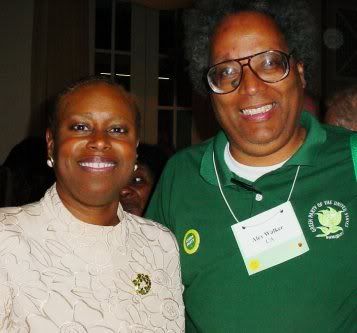
Cynthia
GP Candidate Cynthia McKinney with Alex Walker in Chicago

Very well. My "Brotha" Barack does not need my vote, and since pumping up Dem totals only encourages my local scoundrels, I won't vote for any Democrat in California.

All politics is local.

Surf the Internet and you'll find thousands of posts about Iraq, Iran, Afghanistan, China, Russia, India, Israel, and Palestine. Across the political spectrum, intellectuals obsess over world affairs.

Want to know how the U.S.A. got into this mess? Want to know how we were overwhelmed by cynicism, divisiveness, demagoguery, "Pay-To-Play" governance, and sleaze? It didn't start in that mythical "Washington." It started in places like little Wasilla, Alaska... and big Los Angeles.


I could write a long book about this. Today, I'll be brief, and just list the Dem screw-ups. One great thing about the Internet is that you don't have to take my word for it. Click the hyperlinks below and read the MSM stories for yourself.

One-Party Democratic Los Angeles County
Democrats presided over all of these screw-ups. Many of the scoundrels are people of color. My wife and I have lived all over this country and nowhere have I seen so many political hacks who are Black like me.

The Three "Playboy" Mayors

No essay about ethically-challenged politicians would be complete without a special salute to California's "Playboy" mayors. They've worked hard holding up the Bill Clinton Tradition.

Our "Great" 2-Party System in My Neighborhood

In 2006 in my 33rd congressional district, Democrat Diane Watson received 100% of the vote. Across the street and down the hill, the 35th congressional district was a comparative hotbed of democracy -- Democrat Maxine Waters garnered "only" 83.7% against candidates for the Libertarian and American Independent Parties. My representative to the California state assembly from the 47th assembly district, Democrat Karen Bass, actually had to run against a bona fide Republican.

Here's the message that Republican Jeffers M. Dodge, self-described "tall white fair-haired male political activist," sent to me and my neighbors:

Jeffers MacArthur Dodge

"I have said this many times, Get off drugs, go back to school, stay married, love your children, go to church, get a job and take responsibilities for your actions."

Wow! Like we really needed a Republican "angry white man" to instruct us to love our children. Two years ago voters in law-abiding, tax-paying, working families in my neighborhood reacted to Mr. Dodge exactly the same as voters in law-abiding, tax-paying, working families in any city, suburb, small town or rural county to a stream of insults -- casting 84.87% of their votes for Democrat Karen Bass.

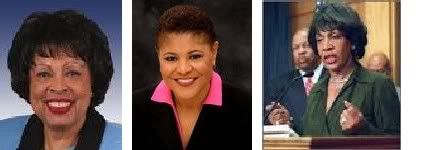
My Dems

Democrats: (left to right): 33rd District Congresswoman Diane Watson, 47th District Assemblywoman Karen Bass, and 35th District Congresswoman Maxine Waters.

The 2008 presidential election may be the most important in modern U.S. history. This year that other "major party" in our sacred 2-party system, is running candidates for all 3 seats.

Republican David Crowley is running against Watson; Republican Lady Cage-Barile is challenging Bass; and Republican Ted Hayes is trying to oust Waters. If you visit their official web sites, you'll find nothing wars in Iraq and Afghanistan; nothing about an economic crisis; and next to nothing about education or health care. You will find, however, that all three are strongly opposed to abortion, same-sex love, and "illegal aliens" from Mexico. On national television Mr. Hayes has said that "illegal immigration is the worst thing for blacks since slavery." Ms. Cage-Barile sends this high-minded message on her official web site:

"For more than a decade, California politics has been led by an Ultra Liberal Controlled Legislation, which has managed to alienate Conservative Americans, Religious Americans and Patriotic Americans from the decision making process... California is left with the low education ranking of 47th in the nation, the largest influx of illegal immigrants ever, a campaign to make men effeminate, irresponsible spending of our tax dollars, constant raising of taxes. . ."
Leave it to Republicans to "reach out" to my African-American community by red-baiting, race-baiting, and homophobia.

Karen Bass has been elected the first African-American woman in history to serve as speaker of a state assembly. Maxine Walters, top-aide to Mayor Tom Bradley in the '70s, Jesse Jackson gal in the '80s, and a legendary liberal in Congress -- co-founding the "Out of Iraq Caucus" -- is a legend. The 3 Democratic incumbents are not worried.

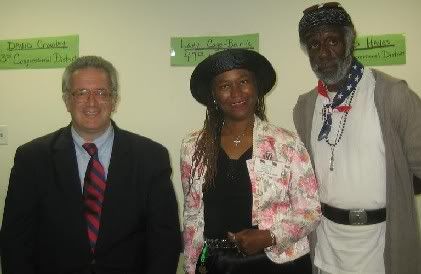
My GOP

Republicans: (left to right): 33rd CD candidate David Crowley, 47th AD candidate Lady Cage-Barile, and 35th CD candidate Ted Hayes.

I mean, look at 'em!

Tell me we don't need the Green Party because I have the "choice" to support these Republican wingnuts and you are telling me, in effect, I need no choice at all.

See below an authentic expression of the heart of the California GOP circulated by a Republican club in San Bernardino County.

Obama Bucks

Hence our dilemma: one-party Democratic regimes are incompetent and corrupt, but the mean, angry, hateful racist Republicans are not an option.

There is a "hole" in U.S. politics. There is an empty space -- a vacuum -- where there ought to be an intelligent, grown-up, no-nonsense opposition to what big city Democrats are doing. The old fashioned politics they represent is as unsustainable in the 21st Century as the old politics of the Bushies.

The Green Party is the second party and the next phase of our struggle begins November 4th.